Beyond Chatbots: How AI Shopping Agents Are Transforming E-Commerce
Context-aware AI shopping agents answer product questions on the page, check compatibility, price, and stock, and help shoppers buy with confidence.
The short answer
A context-aware AI shopping agent is an assistant on every product page that already knows which product the shopper is viewing. It answers questions from the store's catalog and documentation, suggests relevant questions before the shopper types anything, and, with the right integrations, checks compatibility, live price and stock, compares products, and adds items to the cart. Unlike a scripted chatbot, it calls tools against real store data. Done well, it shows where each answer comes from and hands off to a person when it cannot verify one.
Key takeaways
- Page context is the difference: shoppers can ask "How much RAM does this have?" without naming the product.
- Suggested questions for each product let shoppers start a conversation with one click.
- Answers come from the catalog first; external sources only from an approved list, with the source shown.
- Connected tools turn it into an agent: compatibility checks, live price and stock, comparisons, and add to cart.
- Answer quality depends on product data quality, and unanswered questions show exactly where the catalog needs work.
- Measure the impact with a pilot on one category instead of assuming it.
Imagine every product page on your website having its own product expert, ready to answer a shopper’s question the moment they have it.
A customer is looking at a cordless drill and wants to know how long the battery lasts. Another is looking at a laptop and wonders how much RAM it has. Someone else needs to know whether a replacement part fits their model.
Today, most shoppers have to dig through product descriptions, specification tables, manuals, FAQs, or other websites to find these answers. Many don’t. They leave, or they email support and wait.
AI shopping agents are changing that experience.
What is a context-aware AI shopping agent?
Unlike a traditional chatbot, a context-aware AI shopping agent knows which page the customer is on and which product they are asking about.
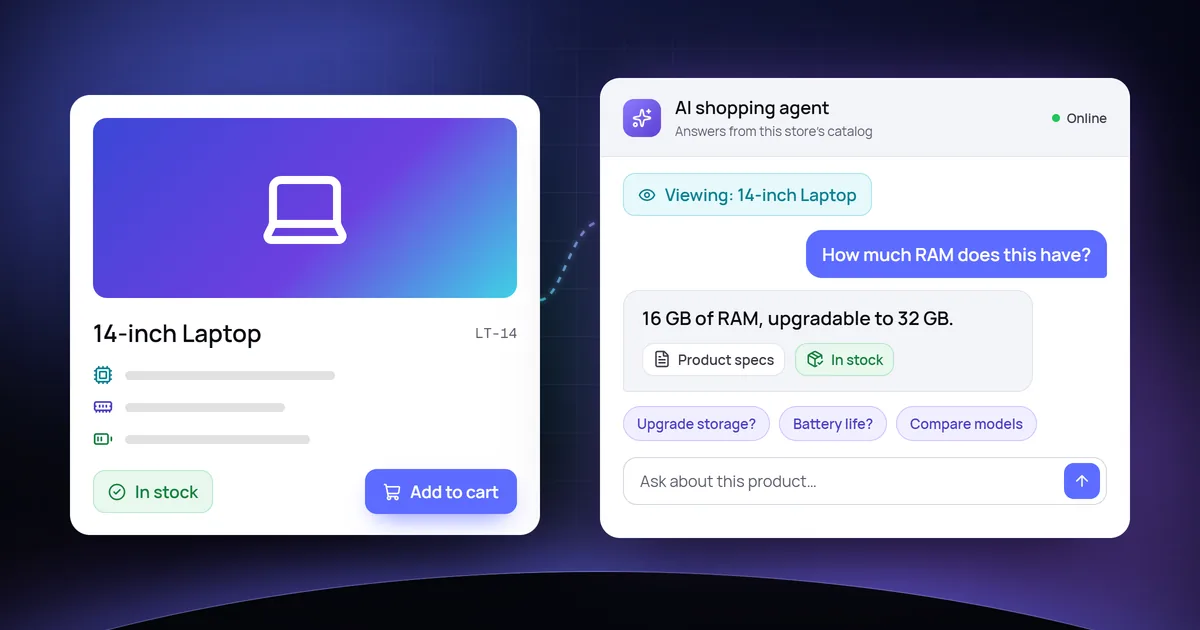
If a shopper on a laptop page asks “How much RAM does this have?”, the assistant already knows which laptop, and which configuration, they mean. It retrieves the product’s specifications and gives a direct answer, without asking the shopper to repeat the product name or model number.
Example
Shopper (on a 14-inch laptop page): How much RAM does this have?
Assistant: This configuration has 16 GB of RAM, and it can be upgraded to 32 GB. Source: product specifications.
Suggested next: Can the storage be upgraded? · What is the battery life? · Compare with the 16-inch model
If the information is missing from the store’s catalog, a more advanced agent can check approved external sources, such as the manufacturer’s documentation, and show the source next to the answer.
The goal is simple: give customers accurate, relevant answers when they need them, without making them do the research themselves.
Let customers start without typing
Many shoppers don’t know what to ask, or don’t want to type. So the best shopping assistants start the conversation for them.
When a customer opens the assistant on a product page, it shows suggested questions for that specific product.
For a cordless power tool, these might be:
- How long does the battery last per charge?
- Which batteries are compatible with this tool?
- How long does it take to recharge?
On a laptop page, the suggestions change:
- How much RAM does this model have?
- Can the storage be upgraded?
- What is the battery life?
Customers can tap a question or type their own. After each answer, the assistant suggests relevant follow-up questions, so shoppers can explore the product naturally, one tap at a time.
More than a chatbot: an AI agent that takes action
A traditional chatbot relies on predefined answers or static knowledge. An AI shopping agent connects to real business data and uses tools: small, controlled actions it can perform on the shopper’s behalf.
Depending on its integrations and permissions, it can:
- Understand the current product. Identify the product, model, and the variant the shopper has selected.
- Retrieve accurate specifications. Read the product catalog, technical attributes, and documentation.
- Research missing information. Check approved manufacturer sources when a detail isn’t in the catalog.
- Verify compatibility. Check whether an accessory or replacement part matches a specific device.
- Compare products. Explain the differences between models in terms of what the shopper needs.
- Check live availability. Get current prices and stock levels through the store’s APIs.
- Assist with purchases. Recommend relevant products and add them to the cart.
- Continue the conversation. Remember earlier questions and suggest useful follow-ups.
That is the difference between a question-and-answer widget and a product advisor. If you are deciding between scripted automation and an agent for other parts of your business, see AI agents vs workflow automation.
| Traditional chatbot | AI shopping agent | |
|---|---|---|
| Knows the current product | No, the shopper has to say it | Yes, from the page and selected variant |
| Source of answers | Predefined replies | Live catalog, documents, approved sources |
| Actions | Links to pages | Checks stock and compatibility, compares, adds to cart |
| When it doesn’t know | Generic fallback | Says so, shows sources, or hands off to a person |
What it takes to get the answers right
A shopping assistant that sounds confident but gets a specification wrong does more harm than no assistant at all. These rules make the difference:
- Catalog first. Answers come from the store’s own product data and documents before anything else.
- Approved sources only. External research is limited to a list the store controls, such as manufacturer sites, and the source is shown with the answer.
- No guessing. If a specification, price, or compatibility can’t be verified, the agent says so and offers to pass the question to the team.
- Clear limits. The agent can read products and add items to a cart. It can’t change prices, issue refunds, or promise delivery dates the store hasn’t confirmed.
- Every question is logged. Unanswered questions show exactly which attributes or documents are missing. Once someone on the team checks an answer found externally, it can be added to the catalog, so every product page improves too.
This is also why product data matters so much. If attributes are incomplete or inconsistent, the agent has nothing reliable to work with. Automating product data management and a shopping agent work best together.
Why this matters for online retailers
Product uncertainty is one of the biggest obstacles in online shopping. Customers hesitate when they can’t confirm a technical detail, don’t understand the difference between two models, or aren’t sure an accessory will fit.
A context-aware shopping agent addresses those doubts at the moment they come up. For retailers, the potential benefits include:
- Fewer repetitive product questions for the support team.
- Better-informed buying decisions, and potentially fewer returns caused by wrong purchases.
- Easier navigation of large or technical catalogs.
- Better product discovery and more relevant recommendations.
- Less friction throughout the buying journey.
These are potential benefits, and they should be measured with real customer interactions, not assumed. Useful measures include:
- The share of questions answered without a handoff.
- Add-to-cart and conversion rates for shoppers who used the assistant compared with those who didn’t.
- The number of product questions reaching support.
- The list of unanswered questions over time.
Bringing AI shopping agents to Magento, Shopify, and WooCommerce
At MarketDyno, we see an opportunity to make this kind of shopping assistance practical for more online retailers, not only the largest brands.
Our approach connects the assistant directly to the store platform, whether that is Magento 2 (Adobe Commerce), Shopify, or WooCommerce. It reads products, variants, prices, stock, and carts through each platform’s APIs, and adds the store’s own manuals and spec sheets as knowledge. The assistant appears on product pages, knows the page it is on, and works within the permissions the store sets. Learn more about our e-commerce automation services and custom AI agent development.
The best way to start is small:
- Pick one category where shoppers ask the most questions before buying.
- Audit the product data for that category and fill the obvious gaps.
- Define the rules: approved sources, what the agent may do, and when it hands off.
- Launch, log, and review the questions and answers every week.
- Expand to more categories when the numbers justify it.
The next generation of e-commerce won’t only help customers find products. It will help them understand what they are buying.
The future of e-commerce is conversational, contextual, and intelligent
AI-powered shopping is moving beyond basic chat windows. The stores that benefit will be the ones whose assistants understand shopper intent, recognize the product in front of them, use reliable information, and help people buy with confidence.
At MarketDyno, we’re exploring how these capabilities can become practical, measurable solutions for online businesses.
Interested in bringing intelligent product assistance to your online store? Contact MarketDyno to talk through your platform, your catalog, and where a shopping agent could help first.
Frequently asked questions
How is an AI shopping agent different from a chatbot?
A traditional chatbot matches questions to predefined answers. An AI shopping agent knows which product page the shopper is on, reads the store's real product data, and can use tools: it can look up specifications, check stock and prices, verify compatibility, compare products, and add items to the cart, within the permissions the store gives it.
What happens when the agent does not know the answer?
It should say so rather than guess. Depending on the setup, it can check an approved manufacturer source and show that source with the answer, or offer to pass the question to the store's team. Specifications, prices, and compatibility should never be invented.
Does it work with Magento, Shopify, and WooCommerce?
Yes. Each platform provides APIs for products, prices, stock, and carts, so the agent can work with live store data on Magento 2 (Adobe Commerce), Shopify, and WooCommerce. The assistant appears on product pages as a widget.
What does a store need before adding an AI shopping agent?
Mainly clean, structured product data: consistent attributes, correct variants, and the manuals or spec sheets customers actually ask about. A short audit of one product category is usually the best first step.