Magento vs. WooCommerce vs. Shopify: An In-Depth Comparison
Compare Magento, WooCommerce, and Shopify on ease of use, customization, pricing, features, and scalability to choose the right platform for your online store.
The short answer
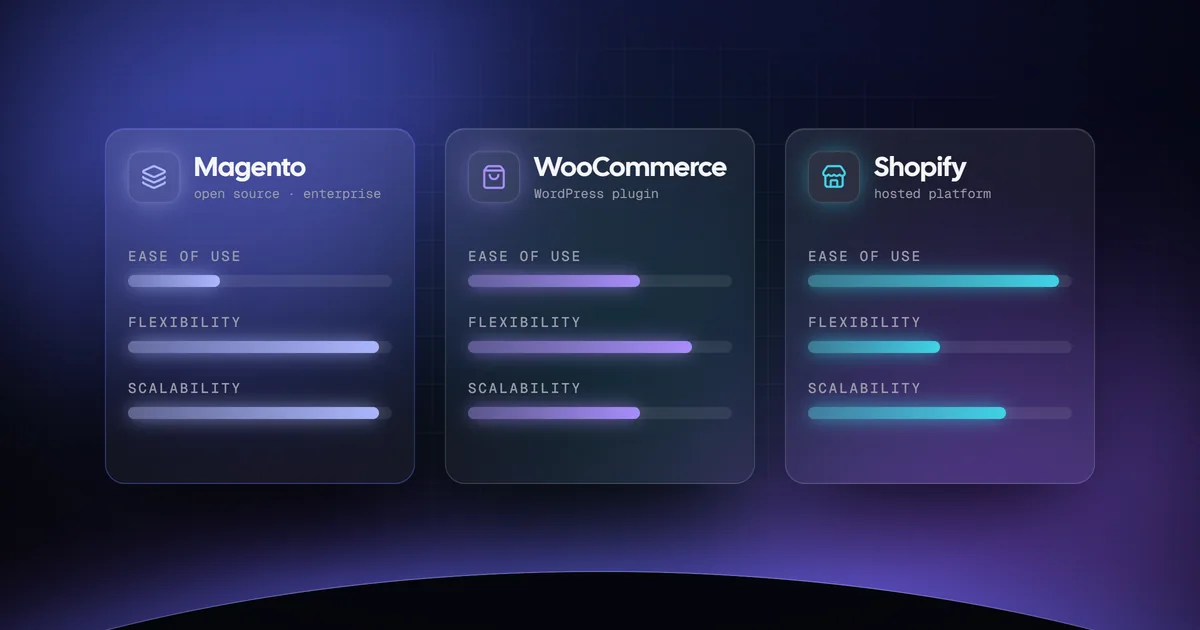
Shopify is the easiest to run and suits small and mid-sized stores that want an all-in-one hosted platform. WooCommerce suits businesses already on WordPress that want flexibility through plugins. Magento (Magento Open Source or Adobe Commerce) offers the most customization and scalability for large or complex catalogs, but needs development resources. The right choice depends on your needs, technical skills, and budget.
Key takeaways
- Shopify is the most beginner-friendly, with a hosted, subscription-based setup and strong built-in features.
- WooCommerce is a free WordPress plugin; the costs come from hosting and paid extensions.
- Magento offers the deepest customization and multi-store features, but it is the most technical to run.
- All three can grow with you, but on Shopify growth often means higher-priced plans, while Magento handles large catalogs natively.
In the world of e-commerce, choosing the right platform can be pivotal for your business’s success. Magento, WooCommerce, and Shopify are three of the most popular e-commerce platforms, each with its own strengths and weaknesses. This article provides a comprehensive comparison to help you decide which is best for your online store.
Ease of use
- Shopify is renowned for its user-friendly interface. It’s designed for beginners, with easy-to-use tools and a straightforward setup process.
- WooCommerce is a WordPress plugin, so it’s a great choice if you’re already familiar with WordPress. However, it can be slightly more technical than Shopify.
- Magento offers powerful features but is the least user-friendly of the three. It’s best suited for those with web development experience or resources.
Customization and flexibility
- Magento stands out for its high level of customization and flexibility, ideal for large businesses with specific needs.
- WooCommerce, being open-source, also offers significant customization possibilities, especially for those proficient in WordPress.
- Shopify provides a range of customizable templates, but it’s somewhat limited compared to Magento and WooCommerce.
Pricing
- Shopify operates on a subscription model with various plans, which can be straightforward but potentially more costly in the long run.
- WooCommerce is free to install, but costs can add up with the need for paid plugins and hosting services.
- Magento is available as the free Magento Open Source edition and as Adobe Commerce (formerly Magento Commerce, or Enterprise Edition). Adobe Commerce can be quite expensive, but it is feature-rich.
Features and functionality
- Shopify offers a comprehensive set of out-of-the-box features, suitable for most small to medium-sized businesses.
- WooCommerce allows for extensive features through plugins, making it highly versatile.
- Magento includes advanced features like multi-store management, and Adobe Commerce adds B2B tools. These are more suited to larger, more complex businesses.
Scalability
- Shopify and WooCommerce are both scalable, but Shopify might require upgrading to more expensive plans as your business grows.
- Magento is highly scalable and can handle large volumes of products and transactions, making it ideal for large enterprises.
Conclusion
The choice between Magento, WooCommerce, and Shopify depends on your business needs, technical skills, and budget. Shopify is best for beginners and small to medium businesses looking for ease of use. WooCommerce is ideal for those already comfortable with WordPress and seeking flexibility. Magento is suited for large businesses requiring extensive customization and scalability. Evaluate your priorities to make the best choice for your online store.