PHP Evolution: In-Depth Comparison of PHP 5, PHP 7, and PHP 8
How PHP evolved from PHP 5 to PHP 7 and PHP 8: object-oriented programming, major performance gains, type declarations, the JIT compiler, and modern syntax.
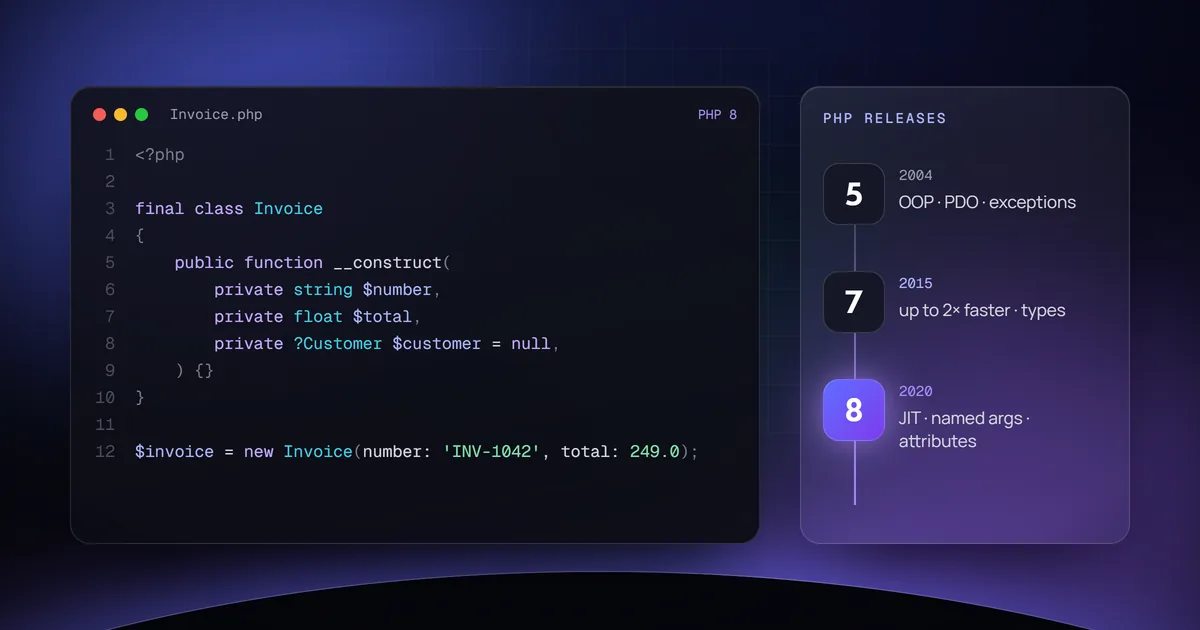
The short answer
PHP 5 (2004) built the foundation with a full object-oriented model, PDO, and exceptions. PHP 7 (2015) offered up to twice the speed of PHP 5.6 with a new Zend Engine and added scalar and return type declarations. PHP 8 (2020) added the JIT compiler, union types, named arguments, attributes, and constructor property promotion. PHP 5 and PHP 7 no longer receive security updates, so applications still running on them should be upgraded to a supported PHP 8 release.
Key takeaways
- PHP 5 introduced a robust object-oriented model, PDO for database access, and exception handling.
- PHP 7 delivered up to twice the speed of PHP 5.6 and added scalar and return type declarations.
- PHP 8 added the JIT compiler, union types, named arguments, attributes, and constructor property promotion.
- PHP 5 and PHP 7 no longer receive security updates; run a supported PHP 8 release.
PHP has been a cornerstone in web development for decades. With each major release, starting from PHP 5, evolving through PHP 7, and arriving at PHP 8, the language has seen significant improvements in terms of performance, features, and developer-friendliness. This article provides a detailed comparison of these three major versions, highlighting their advancements and impacts on the PHP community.
PHP 5: Solidifying the core
Released in July 2004, PHP 5 marked a significant step forward in the PHP language, primarily focusing on object-oriented programming and paving the way for modern PHP applications.
Major features and improvements:
- Object-oriented programming (OOP): PHP 5 introduced a robust OOP model, which included private and protected members, interfaces, and abstract classes. This was a paradigm shift from PHP 4’s basic OOP support, bringing PHP closer to fully object-oriented languages like Java.
- PDO (PHP Data Objects): A new, unified database access layer provided a consistent interface for accessing multiple databases, enhancing security and flexibility.
- Improved XML support: Introduction of SimpleXML and enhanced SOAP support, making web services and XML parsing more accessible.
- Error handling: PHP 5 introduced exception handling, allowing errors to be managed using the
try-catchblock, a common practice in other major programming languages.
PHP 7: Breaking the performance barrier
Skipping directly from PHP 5.6 to PHP 7.0, this release, in December 2015, was a landmark in PHP’s history, primarily focused on performance and modernizing the language.
Key enhancements:
- Significant performance boost: Thanks to the new Zend Engine 3.0, PHP 7 offered up to twice the speed of PHP 5.6, significantly reducing memory consumption.
- Type declarations and return types: PHP 7 introduced scalar type declarations and return type declarations, enabling developers to specify the expected data types in function signatures.
- Improved error handling: Fatal errors were converted to exceptions, allowing more graceful error handling and reducing website downtime.
- Anonymous classes: PHP 7 introduced support for anonymous classes, enhancing the flexibility of coding by allowing on-the-fly class definitions.
PHP 8: Modernizing the language
PHP 8, released in November 2020, continued the trend of performance improvement and feature enhancements, focusing on modernizing the language to keep pace with contemporary programming practices.
Noteworthy features:
- JIT compiler: The Just-In-Time compiler is the headline feature of PHP 8. It compiles parts of the code at runtime, potentially boosting performance, especially in CPU-intensive tasks.
- Union Types 2.0: This feature allows functions to accept and return multiple types of data, providing greater flexibility in function signatures.
- Named arguments: Allowing developers to pass arguments to functions based on the parameter name rather than the order, enhancing code readability and maintenance.
- Attributes (or annotations): PHP 8 introduces attributes, a way to add metadata to classes, methods, functions, parameters, and properties.
- Constructor property promotion: This syntactic sugar allows for more concise and readable class constructor definitions.
Later PHP 8 releases have continued in the same direction, adding features such as enums and readonly properties (PHP 8.1) and property hooks (PHP 8.4).
The impact on web development
Each version of PHP has contributed significantly to the landscape of web development:
- PHP 5 established a solid foundation with improved OOP support, making PHP a viable option for large, complex applications.
- PHP 7’s performance improvements and modern features made it a compelling upgrade, leading to widespread adoption and a renaissance in PHP development.
- PHP 8 continues to push the boundaries, introducing features that align PHP with other modern programming languages, ensuring its relevance in the current programming ecosystem.
PHP 5 and PHP 7 no longer receive security updates. If an application or online store still runs on one of them, plan an upgrade to a supported PHP 8 release.
Conclusion
From PHP 5’s foundational improvements to PHP 7’s performance leaps and PHP 8’s modern features, PHP has evolved to meet the challenges of modern web development. Each version has brought significant improvements, shaping PHP into a more powerful, efficient, and developer-friendly language. As the web continues to evolve, PHP remains a critical tool in the developer’s toolkit, adaptable and robust enough to build a wide range of web applications.