Intelligent Business Automation for Mining Companies in Thunder Bay
How mining companies and suppliers in Thunder Bay can use AI to automate quotes, procurement, inventory, work orders, invoices, and safety paperwork.
The short answer
Mining companies and their suppliers in Thunder Bay can use intelligent business automation to reduce the administrative work around procurement, RFQs and quotations, spare-parts inventory, maintenance work orders, invoices, field reports, and safety records. AI reads emails and documents, matches parts and prices, and prepares drafts, while workflow automation and APIs connect the ERP, accounting, maintenance, and document systems a business already uses. People approve anything that commits money, changes records, or touches safety. The practical way to start is to map one workflow, measure it, automate it as a pilot, and expand what works.
Key takeaways
- Thunder Bay supports 10 active mines, 18+ major exploration projects, and 400+ local mine supply and service companies. Much of their daily work is administrative.
- The best first candidates are repetitive, document-heavy workflows: RFQs and quotes, purchase orders, invoice matching, and work orders.
- AI prepares the work. People approve pricing, part compatibility, contracts, and anything related to safety.
- Automation connects the ERP, accounting, maintenance, and document systems you already have instead of replacing them.
- Measure a baseline first, run a small pilot, and expand only what shows a measurable improvement.
Thunder Bay has become a strategic mining supply and service hub for Northwestern Ontario. According to the Thunder Bay Community Economic Development Commission, the city supports a regional industry of 10 active mines and more than 18 major exploration projects, served by a network of more than 400 local mine service and supply companies. These businesses deliver equipment, engineering services, geological consulting, transportation, maintenance, and industrial supplies.
As the regional mining industry grows, businesses face increasing demands for operational efficiency, accurate reporting, faster procurement, and better coordination between departments.
Buying advanced industrial machinery is only one part of digital transformation. Significant opportunities also exist in everyday business processes, from answering customer inquiries and preparing quotations to managing inventory, processing invoices, and coordinating field operations.
Intelligent business automation helps mining companies and their suppliers improve these processes by combining artificial intelligence, existing business software, and automated workflows.
Understanding the mining business ecosystem in Thunder Bay
Thunder Bay’s mining ecosystem extends far beyond mineral extraction. It includes a diverse network of businesses supporting mining operations throughout Northwestern Ontario:
- Mining equipment manufacturers and distributors
- Geological and environmental consulting firms
- Drilling and exploration contractors
- Industrial maintenance and repair companies
- Engineering and construction contractors
- Equipment rental businesses
- Mineral testing laboratories
- Transportation and logistics providers
- Industrial parts and safety equipment suppliers
- Electrical and industrial automation companies
Although these businesses provide different services, many share similar administrative and operational processes. Understanding these processes is the first step toward finding meaningful automation opportunities.
Key business processes in the mining industry
Mining companies and their suppliers typically manage many interconnected workflows.
| Business process | Common activities |
|---|---|
| Procurement | Supplier selection, purchase orders, price comparisons |
| Sales | Customer inquiries, quotations, order management |
| Inventory | Stock monitoring, spare parts management, replenishment |
| Maintenance | Equipment inspections, repair scheduling, work orders |
| Accounting | Invoice processing, payments, financial reporting |
| Human resources | Employee scheduling, timesheets, certifications |
| Logistics | Shipment tracking, equipment transportation |
| Project management | Resource allocation, progress monitoring |
| Health and safety | Incident reporting, inspections, documentation |
| Geological services | Sample tracking, data management, technical reporting |
| Document management | Contracts, manuals, policies, technical specifications |
| Customer service | Email communication, service requests, follow-ups |
When these processes rely on disconnected software, spreadsheets, manual data entry, or email, businesses end up with unnecessary administrative work, delays, and inconsistent information. Intelligent automation helps connect these workflows.
AI-powered procurement and purchasing automation
Procurement is a critical function in the mining industry. Companies regularly purchase machinery, replacement parts, safety equipment, industrial materials, and specialized services.
A conventional procurement workflow may involve:
- Receiving an internal purchase request.
- Checking existing inventory.
- Contacting several suppliers.
- Collecting and comparing quotations.
- Getting purchasing approval.
- Creating a purchase order.
- Tracking delivery.
- Matching received goods with invoices.
An intelligent procurement system can automate many of these administrative steps.
How AI can improve procurement
- Extract product information from supplier emails and PDF quotations.
- Compare supplier prices and delivery schedules.
- Check existing inventory before creating new purchase requests.
- Prepare purchase orders for human approval.
- Monitor delayed shipments.
- Match invoices against purchase orders and receiving records.
- Produce purchasing and supplier performance reports.
By connecting AI with existing ERP, accounting, and inventory systems, mining businesses can reduce repetitive purchasing tasks while keeping their financial controls in place.
Intelligent RFQ and quotation automation
Mining equipment suppliers frequently receive requests for quotation (RFQs) with technical specifications, part numbers, quantities, and delivery requirements.
Staff may need to review several documents, search product catalogues, contact manufacturers, check inventory, and prepare a customized quotation. This is a strong candidate for intelligent workflow automation.
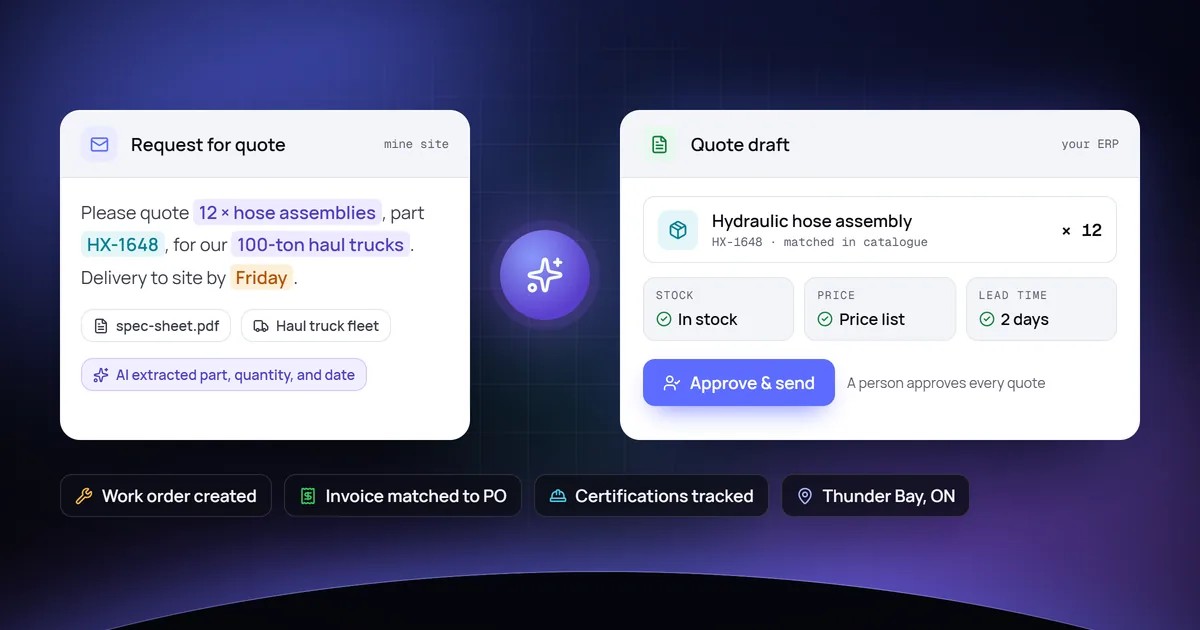
Traditional quotation workflow: customer email → document review → product identification → inventory check → supplier pricing → quotation preparation → customer response → manual follow-up.
AI-powered quotation workflow: customer email → AI document extraction → product matching → inventory and pricing lookup → automated quotation draft → employee approval → customer response → automated follow-up.
An intelligent quotation system extracts the relevant information, retrieves product details, and prepares a structured quotation for an employee to review.
For mining suppliers in Thunder Bay, this approach can shorten response times and help sales teams handle more inquiries without a matching increase in administrative work.
Final product compatibility, pricing, and contractual commitments should always remain subject to human approval.
AI-powered inventory and spare parts management
Mining operations depend on the availability of machinery, consumables, and replacement parts. Missing a critical component can delay maintenance, interrupt production, and increase transportation costs.
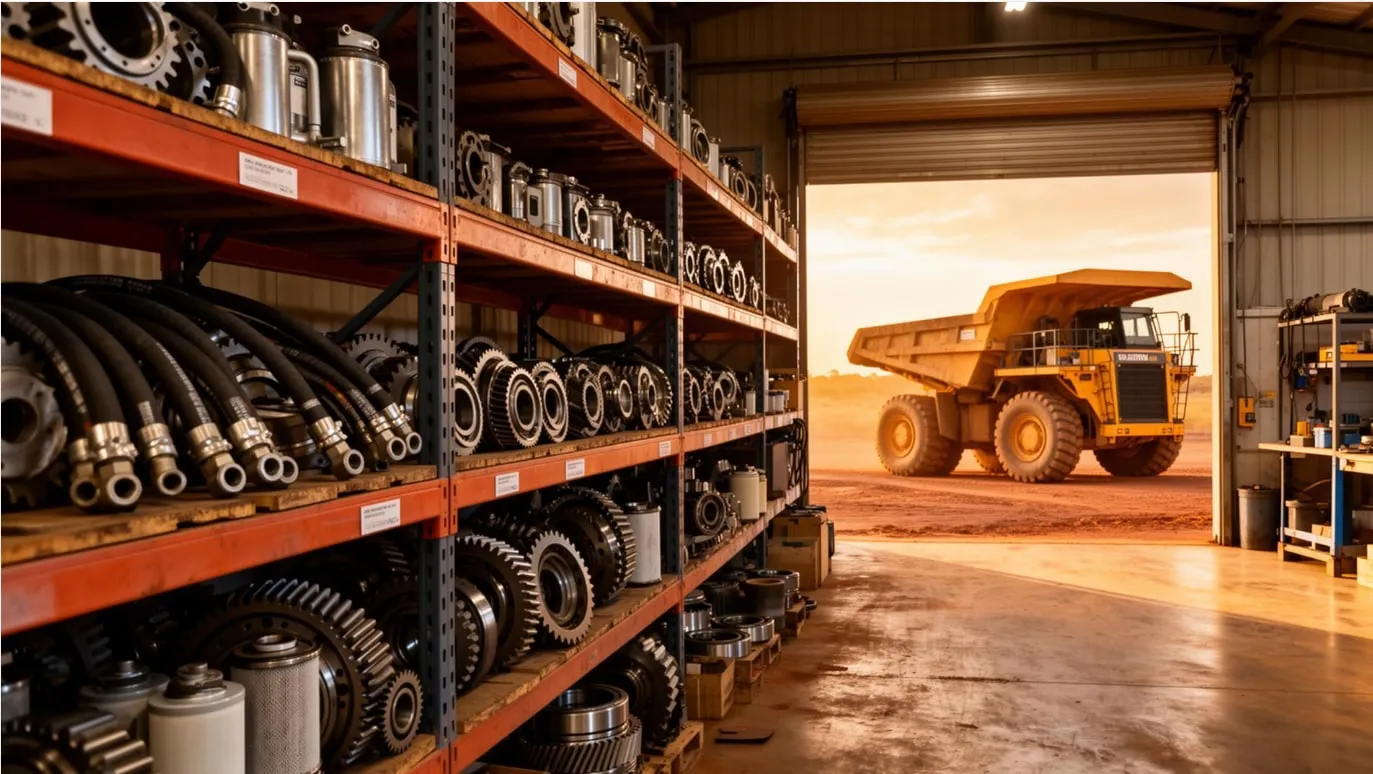
Intelligent inventory management improves visibility across warehouses, suppliers, and maintenance activities. Potential applications include:
- Intelligent spare parts search
- Product catalogue classification
- Duplicate inventory detection
- Automated low-stock notifications
- Demand forecasting
- Supplier lead-time monitoring
- Replenishment recommendations
- Identification of slow-moving inventory
For example, an employee could search for a replacement part by machine model, manufacturer, or technical description instead of relying only on an exact part number. AI retrieves the likely catalogue entries, and technical staff verify compatibility before ordering or installation.
Equipment maintenance and work order automation
Mining businesses operate and maintain a wide range of industrial equipment, vehicles, hydraulic systems, pumps, electrical components, and heavy machinery.
Maintenance management involves more than repairing equipment. It requires coordination between technicians, supervisors, inventory managers, suppliers, and accounting. An intelligent maintenance workflow can support:
- Digital equipment inspection forms
- Automatic work order creation
- Maintenance scheduling
- Technician assignment recommendations
- Spare parts availability checks
- Equipment service history lookup
- Maintenance cost reporting
- Equipment failure pattern analysis
With enough historical maintenance records and reliable sensor data, machine learning can also support predictive maintenance. For businesses without extensive sensor infrastructure, automating work orders, service records, and maintenance documentation is a more practical starting point.
These systems support maintenance personnel. They do not replace qualified technical judgment or safety-critical industrial controls.
Intelligent document and invoice processing
Mining companies handle large volumes of business documents, including supplier invoices, purchase orders, delivery receipts, technical specifications, equipment manuals, service agreements, inspection reports, employee certifications, and environmental documentation.
Intelligent document processing (IDP) combines optical character recognition, AI, validation rules, and workflow automation to turn documents into structured business data.
For example, when a supplier invoice arrives by email, an automated system can:
- Identify and classify the document.
- Extract the invoice details.
- Find the matching purchase order.
- Compare quantities and prices.
- Flag discrepancies.
- Route the invoice for approval.
- Transfer approved information into the accounting system.
- Archive the original document and keep an audit trail.
This reduces repetitive data entry and lets employees focus on exceptions, financial decisions, and supplier relationships.
AI knowledge management for mining companies
Mining organizations build up technical knowledge across equipment manuals, safety procedures, training materials, internal policies, historical reports, and employee experience. As documentation grows, finding the right information gets harder.
An internal AI knowledge assistant lets authorized employees search company information in plain language. Employees could ask:
- Where is the latest maintenance manual for this equipment?
- What documentation do we need to onboard a new contractor?
- Which supplier provides this replacement part?
- What is our internal purchase approval procedure?
- Where are the previous inspection reports for this asset?
Using retrieval-augmented generation (RAG), the assistant retrieves information from approved company documents and answers with references to the original sources.
Access permissions, document version control, and human verification are essential, especially for engineering or safety-related information.
Geological data and exploration workflow automation
Thunder Bay is also home to geological consulting and mineral exploration service providers. Companies such as Bayside Geoscience publicly describe services that include field and drill program management, data compilation and database management, and technical reporting.
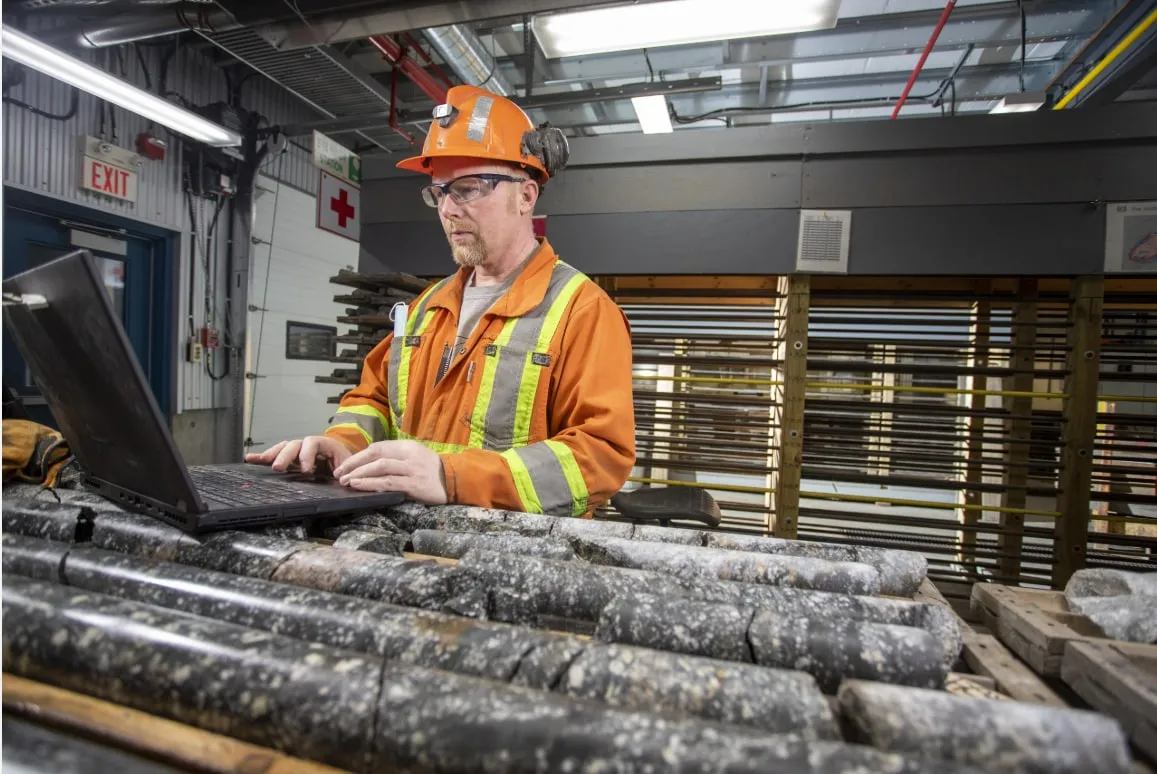
These activities generate large amounts of structured and unstructured information. Intelligent automation can support workflows such as:
- Consolidating historical geological data
- Sample identification and tracking
- Extracting laboratory results
- Organizing drill logs
- Geospatial data processing
- Data quality validation
- Field observation documentation
- Drafting technical reports
- Project progress dashboards
Computer vision, machine learning, geographic information systems (GIS), and remote sensing can also support specialized geological and environmental applications.
Professional geologists and qualified specialists remain responsible for interpreting and validating technical results.
Intelligent field reporting and project management
Field operations generate information through photographs, handwritten notes, spreadsheets, emails, and daily reports. Moving this information into central systems creates more administrative work.
AI-powered field reporting lets employees submit observations through mobile devices, digital forms, photographs, or voice recordings. An intelligent system can then:
- Convert voice recordings into text.
- Extract project and equipment identifiers.
- Organize photographs and supporting documents.
- Generate structured daily reports.
- Flag incomplete submissions.
- Update project dashboards.
- Notify supervisors when follow-up is needed.
For remote mining and exploration projects, offline data collection with secure synchronization is especially valuable where internet access is limited.
Health, safety, and compliance automation
Mining businesses operate in demanding health, safety, and regulatory environments. In Ontario, mining activities fall under workplace safety legislation, including the Occupational Health and Safety Act and Regulation 854 for mines and mining plants.
Intelligent automation can help organizations manage the administrative side of these responsibilities:
- Digital safety inspection forms
- Organizing incident reports
- Tracking employee certifications
- Training expiry notifications
- Tracking corrective actions
- Safety document management
- Audit preparation
- Regulatory reporting reminders
AI should assist with documentation, information retrieval, and administrative coordination. It must not replace mandatory inspections, qualified safety professionals, emergency procedures, or regulatory responsibilities.
Connecting existing business software with AI
Many mining businesses already use specialized software for accounting, inventory, customer relationships, equipment maintenance, and enterprise resource planning. Intelligent automation does not have to replace these systems.
Instead, AI agents, APIs, and workflow automation platforms connect the existing tools. A connected business environment may include:
- ERP systems
- Accounting software
- CRM platforms
- Inventory databases
- Computerized maintenance management systems (CMMS)
- Document management systems
- Email platforms
- Customer and supplier portals
This lets information move between departments without duplicate data entry. Businesses can introduce automation gradually, starting with a single workflow and expanding as requirements become clearer.
Measuring the business value of intelligent automation
Measure the value of automation against real business performance, not assumptions about AI.
| Business area | Performance indicator |
|---|---|
| Sales | Average quotation preparation time |
| Procurement | Purchase request processing time |
| Inventory | Frequency of stock shortages |
| Maintenance | Work order completion time |
| Accounting | Invoice processing cost |
| Documentation | Time spent searching for information |
| Project management | Administrative reporting hours |
| Customer service | Average response time |
| Compliance | Overdue certifications and corrective actions |
Recording baseline numbers before implementation shows whether an automation actually delivers an improvement. A successful implementation demonstrates measurable operational value; it does not simply add another software platform.
How mining businesses can get started
A practical automation strategy starts with understanding your existing processes. (Our guide to finding where workflows lose time and money walks through this in more detail.)
- Business process assessment. Identify repetitive activities, manual data entry, disconnected systems, approval delays, and administrative bottlenecks.
- Workflow mapping. Document how information moves between employees, departments, suppliers, customers, and software.
- Opportunity identification. Decide which activities benefit from rule-based automation, AI agents, document processing, machine learning, or system integration.
- Pilot implementation. Pick one manageable workflow, such as invoice processing, quotation preparation, or internal document search.
- Performance measurement. Compare processing times, administrative workload, error rates, and other indicators against your baseline.
- Integration and expansion. Expand the workflows that work, while maintaining cybersecurity, access controls, human oversight, and business continuity.
Intelligent business automation with MarketDyno
MarketDyno is based in Thunder Bay and helps businesses improve their operations through custom software, AI, and business process automation. For mining companies, equipment suppliers, industrial contractors, and service providers in Thunder Bay and Northwestern Ontario, that can include:
- AI business process automation
- Custom AI agents
- Intelligent document processing
- ERP and CRM integration
- Procurement and quotation automation
- Inventory workflow automation
- Internal AI knowledge assistants
- Custom business software
- Automated reporting and analytics
- Customer and supplier portals
Rather than adding AI without a clear business purpose, MarketDyno starts by understanding your existing workflows and finding practical opportunities for improvement.
Conclusion
The future of mining business automation goes beyond autonomous vehicles, robotics, and industrial machinery. It also means improving the everyday processes that connect employees, customers, suppliers, equipment, and information.
For mining businesses in Thunder Bay, intelligent automation is an opportunity to improve procurement, sales, inventory, maintenance coordination, documentation, and administrative efficiency. By combining existing business systems with AI and carefully designed workflows, organizations can build more connected, responsive, and scalable operations.
Ready to find the automation opportunities in your mining business? Contact MarketDyno to talk through your current processes and see where intelligent automation can help.
References
- Thunder Bay Community Economic Development Commission, Mining Sector: gotothunderbay.ca/key-sectors/mining
- Thunder Bay Mining Supply and Services Directory: miningdirectory.gotothunderbay.ca
- Thunder Bay CEDC, Mining Readiness Strategy Evolution: gotothunderbay.ca/mining-readiness-strategy-evolution-2011-to-2024-and-beyond
- Bayside Geoscience, Professional Services: baysidegeoscience.com/services
- Government of Ontario, Mining Health and Safety Program: ontario.ca/page/mining-health-and-safety-program
Frequently asked questions
What is intelligent business automation for a mining company?
It is the use of AI together with workflow automation and system integrations to handle the administrative work around mining operations: reading RFQs, supplier quotes, and invoices, matching parts to purchase orders, creating work orders, and preparing reports. It works with the systems already in place, and people approve the decisions.
Which workflow should a mining business automate first?
Start with one that is repetitive, document-heavy, and easy to measure, such as RFQ and quotation preparation for a supplier, matching supplier invoices to purchase orders, or searching internal documents. Record how long it takes today so you can compare the result after the pilot.
Do we need to replace our ERP or maintenance software?
Usually not. AI agents, APIs, and workflow tools can connect existing ERP, accounting, CMMS, inventory, and document systems so information moves between them without being typed twice. Replacing a system is only worth considering when it cannot be connected at all.
Can AI make safety or engineering decisions at a mine?
No. In Ontario, mining safety falls under the Occupational Health and Safety Act and Regulation 854 for mines and mining plants. AI can organize inspection forms, track certifications and training, and find the right documents, but inspections, safety decisions, and technical interpretation stay with qualified people.
Can automation work at remote sites with limited internet?
Yes, when it is designed for it. Field reporting tools can collect forms, photos, and voice notes offline and sync them securely once a connection is available, so crews do not have to retype their reports back at the office.
How do we know whether automation is worth it?
Measure a baseline before you start, such as average quotation preparation time, invoice processing cost, stock shortages, or work order completion time. Compare the same numbers after the pilot. If they do not improve, adjust the workflow or stop before expanding it.